
Temporary exhibition
The Art of Computation
From 21 September (opening progressively)
How has the computer, originally designed to calculate, transformed the way we create, represent and interact?
Calculation. That was the computer’s original purpose. Yet from the earliest decades of computing, scientists, engineers, artists and designers realised that these machines could do much more: generate images, invent forms, bring characters to life and open the door to new digital worlds.
The Art of Computation tells part of this story, where computing, creativity and research come together. From pixels to artworks created with algorithms, from the first virtual humans to immersive environments, a common thread emerges: that of women and men exploring the possibilities of still-new machines and gradually pushing the boundaries of what they could be used to create, represent and experience.
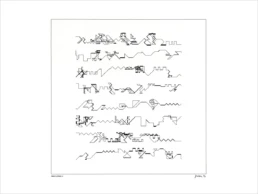
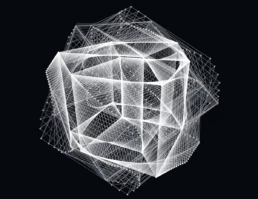
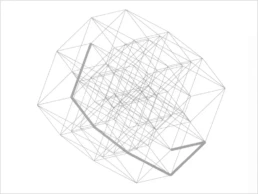
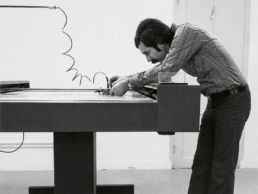
In the late 1960s, Manfred Mohr was among the pioneers exploring the possibilities of computers in artistic creation. Geometry, mathematics and programming became the foundations of a distinctive visual language. The artist develops and writes his own algorithms to give form to his visual ideas. The computer thus becomes a tool in the service of his artistic research.
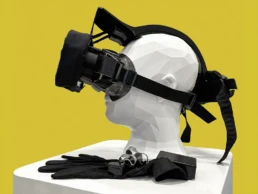
From the 1980s onwards, another frontier was explored: bringing the human form to life in digital worlds. At the University of Geneva, MIRALab, founded by Nadia Magnenat-Thalmann, and at EPFL, VRLab, created by Daniel Thalmann, followed by the Immersive Interaction Group (IIG), led by Ronan Boulic, spent several decades exploring virtual humans, movement, interaction and immersive environments.
And then there is the pixel. A fundamental building block of the digital image, it also becomes a medium for composition. In early graphical user interfaces, as in the experiments of artists and designers, the limitations imposed by machines require choices to be made, forms to be simplified, and new ways of representing things to be invented. Technical constraints thus become a genuine field for creative exploration. A new chapter dedicated to the pixel will soon enrich The Art of Computation.
Objects, archives, films and interactive installations offer different ways to explore this history. The Art of Computation invites us to look at computing from another perspective: not only through its machines and their performance, but through what women and men have imagined doing with them.
Acknowledgements
Manfred Mohr
Algorithms in the Service of an Artistic Language
Manfred Mohr and Estarose Wolfson – For their trust, their time, and for making available the archives and documents presented in the exhibition.
Marielle Stamm – For her support in organising the meeting with Manfred Mohr and Estarose Wolfson, and for donating archival material to Musée Bolo.
Aurélie Agui – Art historian, for her contribution to the installation, her research on the work of Manfred Mohr, and her assistance in documenting its content.
Anne-Sylvie Weinmann – Editor of Mémoires vives, for conducting and producing the interviews with Manfred Mohr and Estarose Wolfson.
Cédric Gaudin – President of the Mémoires Informatiques Foundation, for his participation in the interviews with Manfred Mohr and Estarose Wolfson.
At the Origins of the Virtual
Daniel Thalmann – Professor Emeritus at EPFL and founder of the VRlab, for his trust and support for this project.
Nadia Magnenat-Thalmann – Professor Emerita at the University of Geneva and founder of MIRALab, for her trust and support for this project.
Ronan Boulic – Founder and Director of the Immersive Interaction Group, for his trust and support, and for donating part of the scientific heritage of the VRlab and IIG to Musée Bolo when the laboratory closed in 2026.
mirouille – 3D computer graphics designer at the VRlab for nearly fifteen years, for her invaluable help, for sharing archival material, and for her assistance in selecting and documenting the content presented.
Musée Bolo would also like to acknowledge the work of all the researchers, doctoral students, engineers, students and collaborators who contributed to the research carried out at EPFL’s VRlab, the University of Geneva’s MIRALab and the Immersive Interaction Group.
Project Management
Coordination and Production
Cédric Gaudin and Daniela Perren
Main Partners


Adress
Musée Bolo
INF Building -EPFL School of Computer and Communication Sciences – Level 0 (INF 094.7)
Station 14 – 1015 Lausanne – Switzerland
Exhibition open Monday to Friday, 8 am–7 pm.
Free admission.